Digital Transformation: A Practical Roadmap for Organizations. Explore practical steps, useful tips and key considerations for individuals, schools and organizations.
Digital transformation is often misunderstood as buying computers, installing software or moving files online. In reality, it is about improving how an organization works and serves people by using technology alongside better processes, skills and leadership.
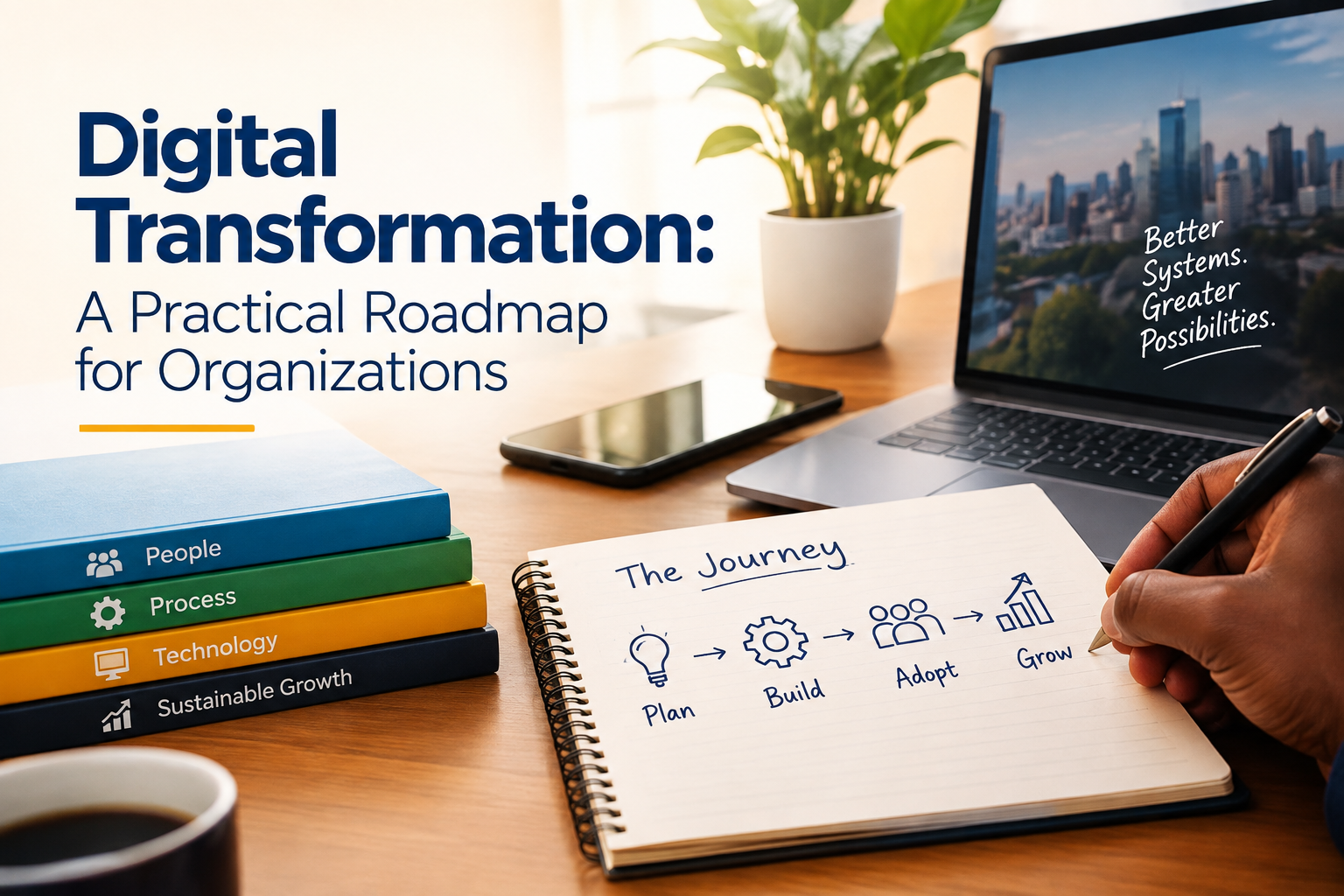
A successful transformation begins with a problem not a product.
Step 1: Understand the current situation
Map how work is currently done. Where do delays occur? Which tasks are repeated? What frustrates staff or customers? Gather feedback from the people who use the process every day.
Step 2: Set a clear goal
Choose a specific outcome, such as reducing the time needed to process applications, improving customer response, or making records easier to retrieve. Avoid vague goals like “becoming fully digital.”
Step 3: Review readiness
Assess internet access, devices, staff skills, data quality, security and available budget. A solution that assumes reliable connectivity may fail in a location where power or internet access is inconsistent.
Step 4: Select the right solution
Compare tools based on usability, cost, security, accessibility, integration and support. Consider whether an existing system can be improved before purchasing a new one.
Step 5: Start with a pilot
Test the solution with one team, department, school or service. A pilot helps identify problems while the project is still small enough to adjust.
Step 6: Train and support people
Technology adoption is a people issue as much as a technical one. Provide practical training, simple guides and a way to ask questions. Involve staff early so they understand why the change is happening.
Step 7: Protect data
Decide what information is collected, who can access it, how long it is retained and how it will be protected. Build privacy and security into the project from the beginning.
Step 8: Measure results
Use a few meaningful indicators: time saved, error rates, user satisfaction, service completion, system availability or cost per transaction. Compare results with the starting point.
Step 9: Improve and scale
Use pilot feedback to fix problems. Expand gradually only when the solution is useful, secure, supported and financially sustainable.
Common mistakes to avoid
Buying technology before understanding the problem; underestimating training; ignoring people with disabilities or limited connectivity; migrating poor-quality data without cleaning it; and assuming a launch means the project is complete.
A simple example
A school wants to improve attendance records. Instead of immediately purchasing an expensive platform, it can map its current process, identify the main delays, test a simple digital register with a few teachers, train users, protect student data and measure whether reporting becomes faster and more accurate.
Final thoughts
Digital transformation is a continuous process of learning and improvement. Organizations that begin with clear needs, involve users, protect information and measure outcomes are better positioned to make technology deliver practical value.